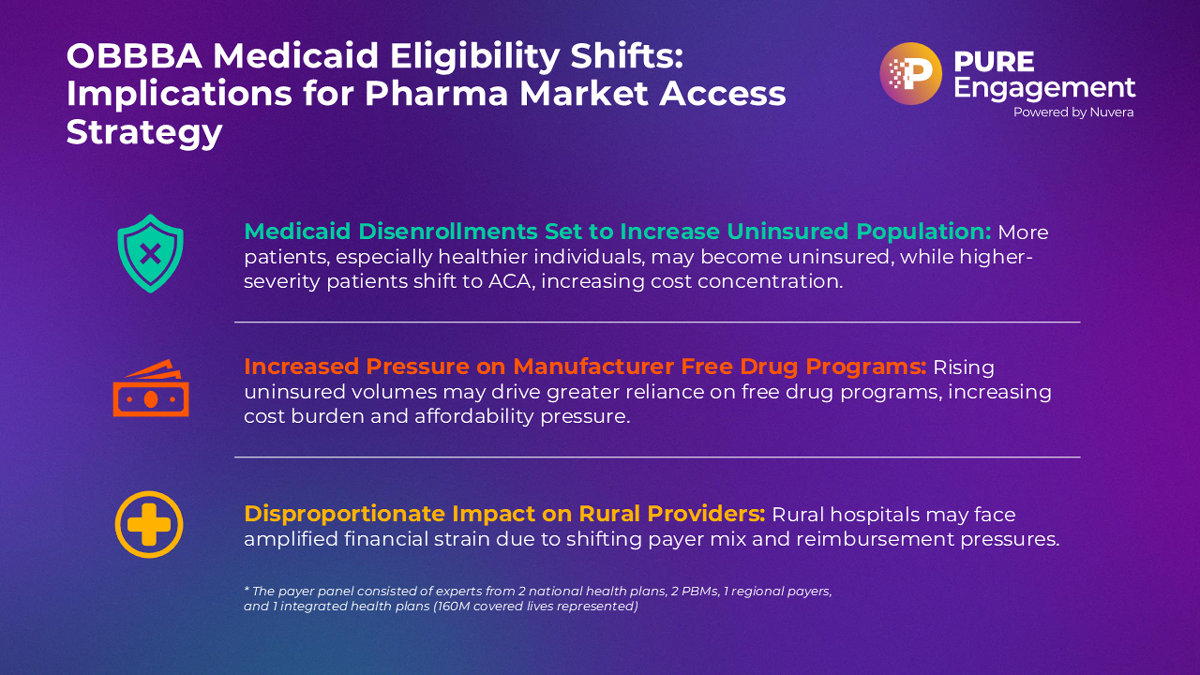
OBBBA Medicaid Eligibility Shifts: Implications for Pharma Market Access Strategy
Medicaid eligibility changes linked to the OBBBA framework are expected to create meaningful shifts in coverage dynamics across the U.S. healthcare landscape. Payer stakeholders anticipate that the downstream impact will extend beyond enrollment churn, shaping affordability exposure, provider decision-making, and the evolving role of patient support programs. Insights from the PURE Engagement’s 2026 payer interviews suggest manufacturers should prepare for a more volatile and complex access environment.
This analysis highlights three key implications:
- Coverage Volatility Will Increase Access Uncertainty
- Provider Risk Could Influence Adoption and Continuity
- Access Strategy Must Become More Dynamic
1. Coverage Volatility Will Increase Access Uncertainty:
One of the most immediate implications is increased uncertainty in coverage continuity. Payers expect many healthier individuals to lose Medicaid eligibility to become uninsured rather than successfully transitioning to alternative coverage. At the same time, patients with greater clinical need are more likely to move into ACA marketplace plans with variable cost-sharing structures. This divergence introduces greater variability in payer mix and benefit design exposure, potentially affecting therapy initiation timelines, and overall predictability of access pathways.
2. Provider Risk Could Influence Adoption and Continuity:
At the provider level, reimbursement and operational pressures are likely to intensify. As uninsured patient volumes rise, practices – particularly rural and community providers – may face greater financial risk associated with initiating or continuing high-cost therapies. This dynamic could influence prescribing behavior, site-of-care decisions, and engagement with manufacturer-sponsored support services. Strengthening provider-facing access infrastructure, including proactive field reimbursement engagement and streamlined enrollment and benefits navigation processes, may become increasingly important to maintaining treatment access.
3. Access Strategy Must Become More Dynamic:
Taken together, OBBBA-driven Medicaid shifts reinforce a broader trend toward more fluid and interconnected access conditions. As coverage transitions continue to unfold (e.g., Medicaid to commercial or uninsured), a greater share of patients are expected to become uninsured or underinsured, with payers anticipating that manufacturers will absorb a larger share of the financial burden through expanded copay assistance utilization, increased reliance on patient assistance programs (PAP), and heightened exposure to 340B pricing as safety-net providers manage growing volumes of uninsured and underinsured patients.
In this environment, market access strategy may need to evolve toward greater agility, with manufacturers investing in scenario planning around payer mix changes, exposure modelling, and monitoring affordability utilization trends, while strengthening field reimbursement and office staff training and embedding patient support more strategically within the treatment journey. At the same time, manufacturers may need to revisit program scalability, eligibility frameworks, and long-term affordability spend assumptions as part of broader access planning to sustain patient access, reinforce provider confidence, and navigate an increasingly dynamic reimbursement landscape.
Latest Insights
Jump to a slide with the slide dots.

 Ashwini Chidirala
Overcoming the Challenges in Bringing Cell & Gene Therapies to Market
Overcome CGT capacity challenges with strategies for forecasting, staffing, and treatment center partnerships.
Read more Ashwini Chidirala
Overcoming the Challenges in Bringing Cell & Gene Therapies to Market – Part 2
How CGT manufacturers can reduce treatment center burden through better workflows, training, logistics, and system integration.
Read more Ashwini Chidirala
Overcoming the Challenges in Bringing Cell & Gene Therapies to Market – Part 3
How CGT manufacturers can reduce financial risk and reimbursement burden for treatment centers adopting commercial therapies.
Read more
Free Drug and Access Equation: What Regeneron’s Otarmeni Decision Reveals About Specialty Product Access
Free drug removes price barriers, but Otarmeni shows why specialty therapy access still depends on PSPs, payers, and logistics.
Read more Ashwini Chidirala
Overcoming the Challenges in Bringing Cell & Gene Therapies to Market – Part 4
As cell and gene therapies (CGTs) continue to enter the market, treatment centers have become the primary gatekeepers...
Read more